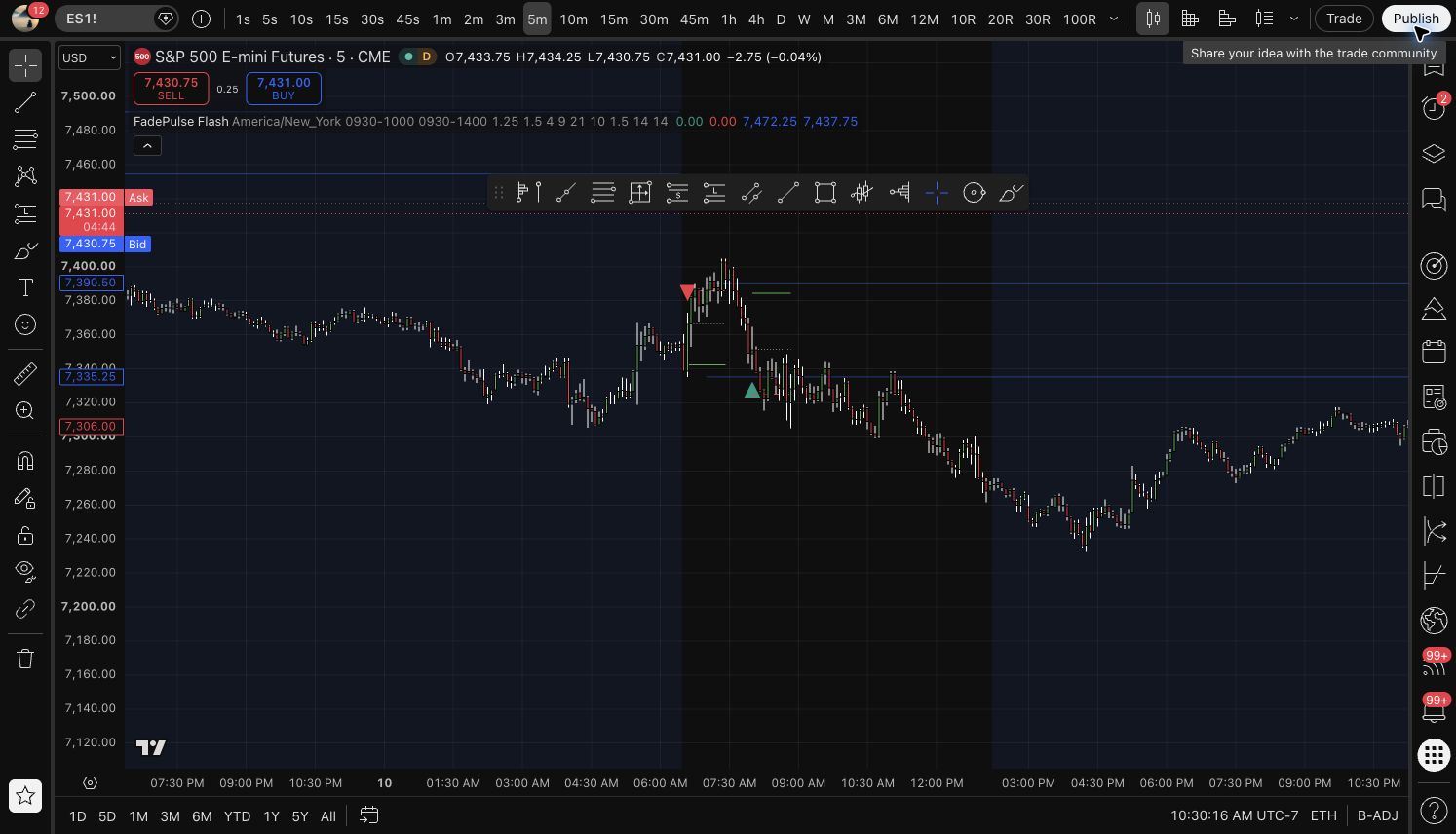
MES/MNQ micro futures, referenced against CME product specs for contract size and tick structure.
CME MES specsCME MNQ specs
Failed-auction scalp candidate
Fade Pulse Research
A faster failed-auction branch with useful trade frequency and a cleaner drawdown profile than the broad failed-auction set.
Trades112closed historical signals
Target RR~1.25Rfailed-auction branch target
Win rate61.6%69 wins / 43 losses
Net return+31.9Rnormalized risk units
Profit factor1.66gross wins / gross losses
Max drawdown4.36Rhistorical path
Expectancy+0.284Rper trade
SymbolsMES: 91, MNQ: 21observed trades
StatusResearch shelfpublic evidence
Target/RR Profile
~1.25R target profile. failed-auction branch target. The displayed RR is the modeled take-profit multiple from the research artifacts; live fills can vary with slippage, fees, and platform execution.
Equity Curve Preview
public evidence
What this means
Research read
- A better fast-candidate shelf item than the raw broad failed-auction module.
- Monte Carlo p05 remained positive in the historical bootstrap.
- Still needs forward-paper parity before it becomes an automation candidate.
Monte Carlo and shelf fit
Public risk evidence
MC p05 final+12.1Rbootstrap downside
MC p50 final+31.8Rmedian simulation
MC p95 DD11.4Rstress drawdown
Below zero0.4%simulated paths
Prop math layer
Open PDF brief
How to read the prop-firm numbers
The PDF turns the strategy stats into a modeled eval-style plan: risk per trade, historical max drawdown in R, Monte Carlo stress drawdown, pass/fail windows, and a forward-test checklist. Free C-tier pages are published as learning research; B/A-tier pages keep exact locked rules private.
TradingView buyer preview
PineScript chart proof
LuxAlgo Quant AI baseline compiled in TradingView Pine Editor on the CME_MINI:ES1! chart. The public page shows the compiled chart preview; Pine delivery is kept out of public_html so the site does not leak scripts accidentally.
Testing method and sources
Audit trail
This dashboard is a public summary of local historical replay output. The visible stats are generated from closed-trade artifacts; exact rules, raw files, and code are only exposed when the strategy is free/unlocked.
Historical replay artifacts were built from local ATAS/Databento research exports and Databento historical-data pulls where available.
Databento Historical APIStats use R-multiple closed trades, equity-curve reconstruction, Monte Carlo bootstrap paths, and modeled prop-style pass/fail stress tests where enough sample exists.
Not live audited. Results can change with fees, slippage, missed fills, latency, contract rolls, prop-rule changes, or market regime shifts.
Risk note
Strategy research is educational software and trading research, not financial advice. Backtests and simulations can fail in live markets because of fees, slippage, latency, platform behavior, regime changes, and user execution.