MES/MNQ micro futures are referenced against CME contract specs for size and tick structure.
CME MES specsCME MNQ specsProp Eval Blend 80
Validation packet for the current best conservative prop-speed upgrade: Opening Range Baseline plus the prior-session failed-auction short module. This is still research, not a live-funded trading approval.
Trades457
Win Rate80.7%
Target RR0.3-1.25R
Net R+78.5
Max DD5.51R
Target/RR Profile
0.3-1.25R target profile. OR/IB scalp plus 1.25R sweep add-on. The displayed RR is the modeled take-profit multiple from the research artifacts; live fills can vary with slippage, fees, and platform execution.
Equity Curve
Risk Read
At $350 risk/trade, this blend aims for much faster eval progress than Goat alone while keeping failure risk under the aggressive branches.
Module Split
| Module | Trades | Win | Net R | PF |
|---|---|---|---|---|
| Opening Range Baseline | 353 | 86.1% | +46.0 | 1.87 |
| Prior Sweep Rank01 | 104 | 62.5% | +32.5 | 1.75 |
Daily Quality
| Sharpe approx | 4.37 |
|---|---|
| Sortino approx | 6.87 |
| Ulcer index | 1.54R |
| Positive active days | 80.3% |
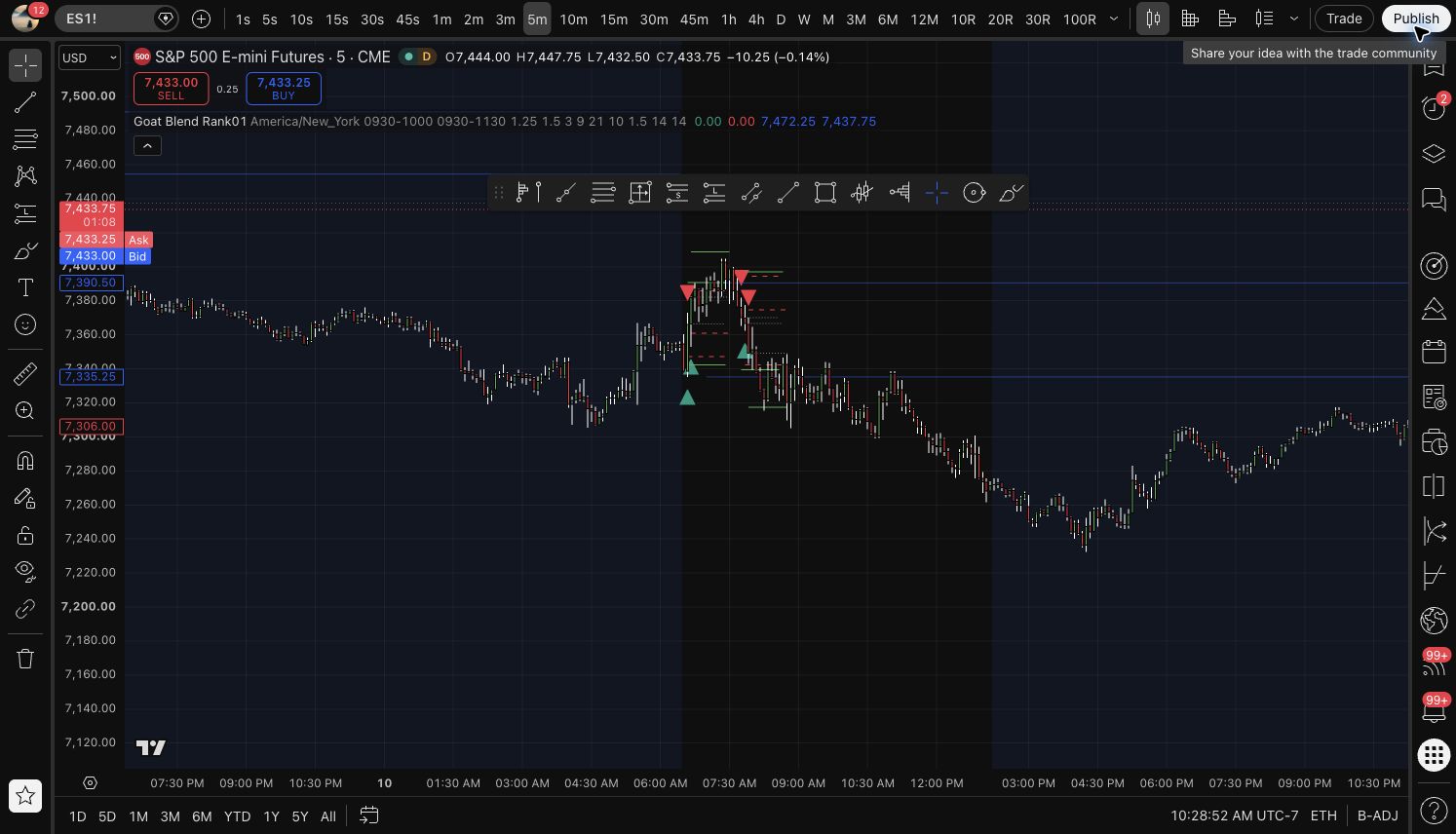
TradingView buyer preview
PineScript chart proof
LuxAlgo Quant AI baseline compiled in TradingView Pine Editor on the CME_MINI:ES1! chart. The public page shows the compiled chart preview; the Pine source stays in the private buyer deliverable packet.
Testing Method and Sources
This page is a public validation summary generated from local historical replay artifacts. Exact rules, source code, and raw signal files stay private unless the strategy is free/unlocked.
Replay files came from local futures research exports and Databento historical pulls where available.
Databento Historical APIStats use closed trades, R-multiple expectancy, equity reconstruction, Monte Carlo bootstrap, and modeled prop-style pass/fail stress tests.
Not live audited. Fees, slippage, latency, missed fills, roll handling, platform behavior, and market regime changes can alter results.